


Marco Lopez Supporting High Performers to Unlock Focus, Confidence, and Peak Performance Under Pressure
Marco Lopez is an author, speaker, and Peak Performance Strategist with more than a decade of experience studying how the mind shapes human potential. A former tech executive, Lopez has dedicated his career to supporting individuals in eliminating subconscious blocks that hold them back from next-level success in life and business. Raised by parents deeply interested in personal growth, Lopez developed an early curiosity about the relationship between mindset, performance, and fulfillment.
Interview
Marco Lopez is an author, speaker, and Peak Performance Strategist with more than a decade of experience studying how the mind shapes human potential. A former tech executive, Lopez has dedicated his career to supporting individuals in eliminating subconscious blocks that hold them back from next-level success in life and business. Raised by parents deeply interested in personal growth, Lopez developed an early curiosity about the relationship between mindset, performance, and fulfillment.
Mentored by Bob Proctor and trained across disciplines spanning music, business, and psychology, Lopez left a successful career in tech to build Mindtune, a company focused on helping people break through mental resistance and operate with clarity and higher capacity. As a trilingual leader and professionally trained opera singer who has spoken internationally, Lopez has worked with more than 5,000 professionals and leadership teams worldwide. For more than nine years, he has been developing the Mindful Optimization Method, better known as M.O.M., designed for high performers and leaders carrying heavy responsibility.
Today, Lopez works with entrepreneurs, executives, and leadership teams who want to move from constant pressure to calm, focused execution. In this conversation, he shares the experiences and principles behind the work that became Mindtune.
Q: We’d love to start by hearing more about the background of Mindtune. You’ve been working on it for about ten years, but it sounds like the roots go much further back. Where did this journey begin for you?
Mindtune has been officially around for nine years, but in truth, it has been a lifelong pursuit. I grew up with both parents who were deeply passionate about personal growth and reaching God-given potential, yet, in their efforts, each struggled with their own mental hurdles.
My mom dealt with depression, anxiety, and low self-esteem, while my dad pushed himself and others overbearingly and relentlessly. When we lived in Puerto Rico, while he was building a network marketing business, he developed a tremor in his hand from constant pressure and overexertion. Watching both of them taught me that desire alone isn’t enough. How you use your mind matters.
We moved around 40 times before I was ten, and I grew up speaking Spanish and English, exposed to many cultures and ways of living. Music became another language for me. My mom taught me and my 4 siblings to sing, and I learned early that music was a powerful way to connect emotionally.
As a teenager, I experienced strong emotional ups and downs and struggled with inconsistency. I often felt like something was wrong with my brain because I never knew which version of myself I would get from one day to the next. That pushed me into searching through spiritual books and personal development.
From my mom, I learned about flow and that life should be motivated by love, a greater power, and a greater purpose. From my dad, I learned about overcoming subconscious blocks. After my parents divorced, my dad began writing about mental calmness and quieting the mind. He realized that his previous intensity wasn’t the answer and was, in fact, a big part of the problem. He spent years living close to nature and uncovering deep insights about how to optimize the mind, which became a major foundation for Mindtune.
Q: Was there a specific moment or series of experiences that clarified your direction and led you to build Mindtune as a company?
As I was pursuing a professional music career as an opera singer, another defining moment occurred. I was performing live on stage in front of a large audience in Brazil, and all of a sudden, my voice cracked right on the high note. The more I sang, the more my voice cracked. I was so devastated that my singing career came to an end. I didn’t sing again for nearly 20 years until I realized the lesson: trying to force outcomes does NOT work. Letting go and letting God does.
My biggest passion in singing was bringing light and joy, and when that ended, I felt hopeless, like I had no purpose anymore. And that’s when I went on my journey of building Mindtune, to overcome the subconscious blocks that were holding me back from being the best version of myself.
There weren’t really any jobs for someone who wanted to teach these deep principles in the way I did, so I started to work in the tech industry. I worked for a software company that eventually sold for $7 billion, launching their Latin American division.
What triggered my departure was a tragedy in my family. My then-wife’s brother took his life. It was a terrible experience for our family, but it awakened something in me. The dream I had of supporting people to overcome internal limitations had been sleeping while I was in tech, and this reminded me of my true calling.
So, I left without knowing exactly what I would do, but I knew I needed to move in the direction of training and teaching. I started looking for roles where I could teach adults on stage or in classrooms and share these principles. I ended up working as a software trainer for a while.
During that period, I went through a divorce. Later, I remarried, and my new wife supported me in taking another leap. We said, “Okay, we’re going to start Mindtune.” I realized that all the time and energy I had spent working on myself just to function at a “normal” level became incredibly valuable to other people who wanted to operate at an even higher level.
I got certified under Bob Proctor’s program, which gave me even more confidence. I taught his material for the first year, and then I began teaching the Mindful Optimization Method, better known as M.O.M., designed for high performers and leaders carrying heavy responsibility.
“I didn’t sing again for nearly 20 years until I realized the lesson: trying to force outcomes does NOT work. Letting go and letting God does.”
Q: You took several financial steps backwards along the way. How did you mentally prepare yourself to do that?
Sometimes, aligning with who you really are requires a financial step back before it becomes a step forward. I left a high-paying tech job and, at one point, worked at a ropes course for $9 an hour, facilitating leadership activities. I thought, “I have all these principles inside of me. This is a perfect place to experiment with teaching them.”
People were blown away by what I shared. I started receiving big tips and strong feedback. That supported me in affirming that what I was teaching was invaluable.
The key for me was prioritizing feeling over logic. I always cared more about reaching my potential than about making money – even though money is very important.
My big hurdle was learning to trust myself more than external opinions. From the outside, my moves looked illogical. But internally, I knew they were right.
Q: Who tends to benefit most from Mindtune, and what would you say to leaders who feel too busy to work on their mindset?
Originally, I was focused on entrepreneurs dealing with fear, anxiety, and uncertainty. Over time, that has evolved.
Today, I support leaders in eliminating subconscious blocks holding them back from achieving higher levels of success in all areas of life and business: leaders with teams, payrolls, families, and constant demands. They often feel like they’re hitting a ceiling because they can’t possibly do more.
What they don’t realize is that they don’t need to carry all that weight consciously. When you learn to eliminate subconscious blocks and delegate heavy thinking to the subconscious mind, you free yourself to operate with clarity and higher capacity. Mindtune is really for people who want to move from internal pressure and limitation into calm, focused execution.
Most people say, “I’ll work on this when my life calms down,” but that’s exactly why they need it. Life doesn’t calm down on its own.
The best time to implement Mindtune is in the middle of the busyness. When you change how your mind operates, you become dramatically more efficient. You start to see that the feeling of busyness comes from using the mind ineffectively.
“When you change how your mind operates, you become dramatically more efficient.”
Q: What makes Mindtune different from traditional coaching, and what kind of results do Mindtune students experience?
Mindtune isn’t just coaching. It’s a deep mind optimization system. It teaches you how your mind actually works and how to access peak performance moment by moment.
This isn’t about doing a single meditation and hoping you feel calm. It’s about understanding the physics of your mind and learning how to use it in a way that bypasses mental blocks so that you can operate at your best and just flow throughout the day. It’s practical, continuous, and applicable in real time.
Because of that, people see results very quickly. I’ve seen people multiply their efficiency after a single 20-minute training. People also see financial results very fast. After 6 months of training, a Mindtune student who started at $0 revenue achieved $25K in monthly recurring revenue.
Several Mindtune students have doubled and even tripled their income after implementing the Mindtune methodology. You get paid based on the level of value you contribute. When subconscious blocks dissolve, your level of service rises. And when your level of service rises, your income grows.
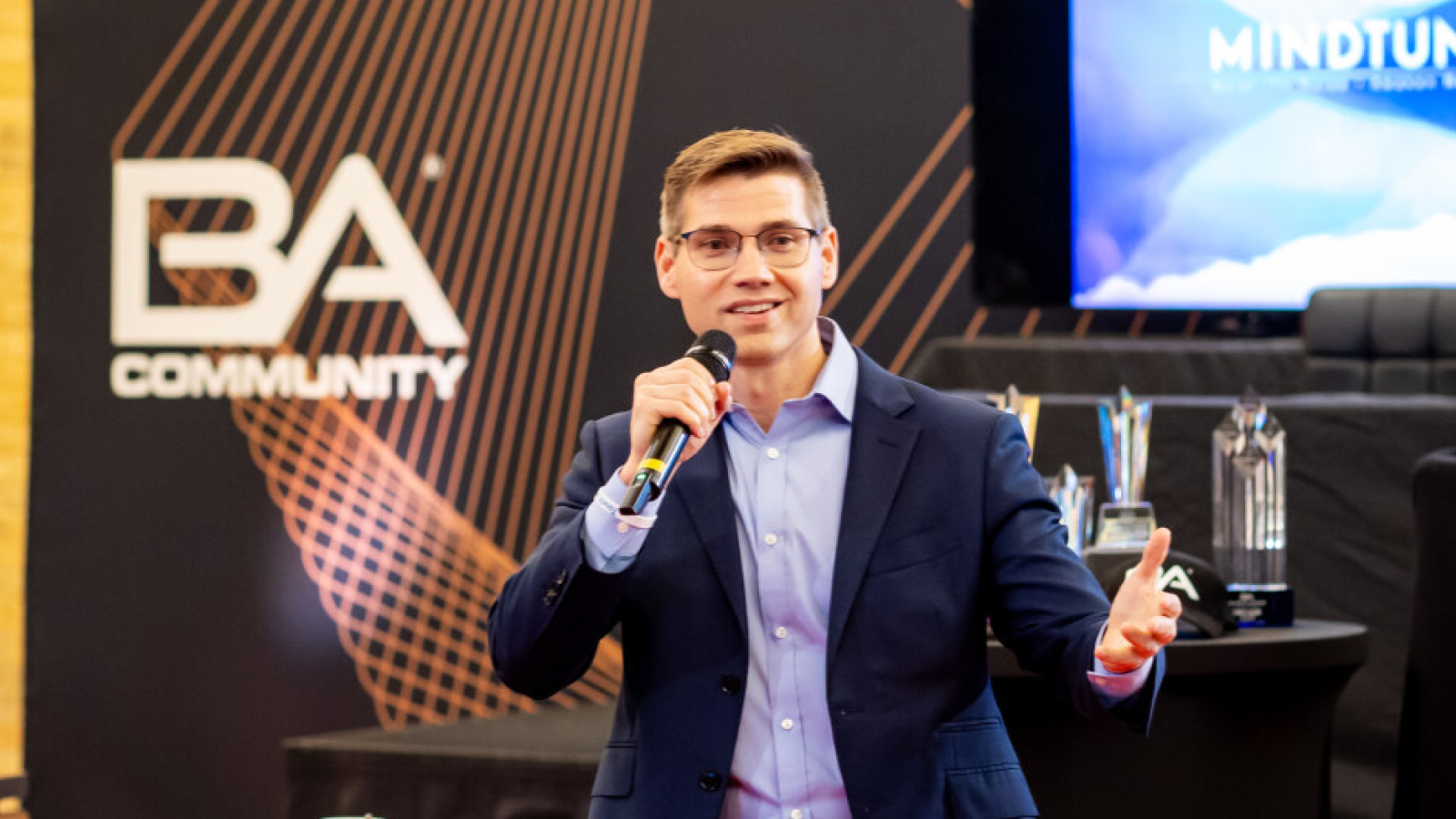
Q: You’ve also spent significant time with the BA Community. From your perspective, how has being part of a high-level peer group impacted you and the growth of Mindtune?
It’s been very helpful because it’s connected me with people who have high-level expertise. I feel like I’ve tapped into international-level experts, who I’ve genuinely needed to support me.
Two big things have come from BA. First, I’ve gained many mentors. Second, I’ve built a much stronger team. Members like Rey Perez and Cheryl Snap Connor have been instrumental in supporting me in amplifying the Mindtune message.
Our team has grown. We now have many advisors and people working with us, and that is directly because of the BA community and the relationships I’ve formed there.
I’m also very grateful for the opportunity I’ve had to serve several BA members through Mindtune. The feedback I have received is that members have increased their efficiency, sharpened their focus, and deepened their purpose. That means a lot to me.
Q: As AI accelerates and the future of work continues to shift, what core belief or inner anchor do you think leaders and entrepreneurs need most?
AI is a multiplier. It multiplies what you already have. If you don’t know your purpose, AI just accelerates confusion.
Most people’s lives are being robbed by mental blocks in the form of stress, worry, external pressure, resentment or other unnecessary thoughts. And these blocks are robbing them of a lot more than they think – leaders must quiet their minds enough to discover their unique song, their purpose, their unique contribution. When you get that clarity, intuition guides your next steps.
Once you have that clarity, AI can amplify it. Most people miss this because they stay constantly busy. I always say the future belongs to people with vision.
Q: You run a business and have five kids. How do you personally find stillness?
I make it a priority. I do one thing at a time. I use systems to stay organized so my mind doesn’t have to carry everything. When you understand universal laws and how things work, you stop forcing and start trusting.
That’s what creates stillness for me.